
Side Bets in Baccarat: A Full Breakdown of Risks and Real Mathematics

Baccarat is often perceived as a low-volatility table game, especially when players focus on Banker or Player bets. The picture changes radically once side bets enter the equation. These optional wagers promise high payouts, visual excitement, and a sense of strategic depth, yet their mathematical structure tells a very different story. Understanding how side bets actually work is essential for anyone who treats bankroll management seriously.
What Baccarat Side Bets Really Represent
Side bets in baccarat are not extensions of the core game mechanics. They are independent probability events layered on top of the main Banker and Player outcomes. While the standard game is built around relatively stable odds, side bets introduce variance that is closer to slot-style risk than classic table play.
Casinos promote these bets because they generate higher margins per hand. For players, the attraction lies in the illusion of control and the appeal of rare but visually striking outcomes. The mathematical reality, however, is that these bets are priced far less favourably than the core wagers.
To evaluate them properly, it is necessary to strip away presentation and focus on probability distribution, payout ratios, and long-term expected value rather than short-term results.
Player Pair and Banker Pair Explained
Player Pair and Banker Pair bets pay out when the first two cards of either hand form a pair. Typical payouts range from 11:1 to 12:1 depending on the ruleset. At first glance, this seems generous, especially when pairs appear sporadically during live play.
From a mathematical standpoint, the probability of a pair occurring in a standard eight-deck shoe is low. This results in a house edge of approximately 10.3% to 11.0%, depending on whether commission-free rules apply. This places pair bets among the least efficient wagers at the baccarat table.
The danger lies in frequency bias. Players tend to remember streaks of pairs and ignore the long sequences where none appear. Over hundreds or thousands of hands, the negative expectation becomes statistically unavoidable.
The Tie Bet and Its True Cost
The Tie bet is often presented as a natural third option alongside Player and Banker. In reality, it operates on a completely different risk profile. While payouts commonly sit at 8:1 or 9:1, the underlying probability is far lower than many players intuitively assume.
Ties occur infrequently, and their rarity is not compensated adequately by the offered payout. This mismatch between probability and reward is the core reason the Tie bet remains one of the most profitable options for casinos.
Understanding the Tie bet requires accepting that visual symmetry at the table does not translate into fair mathematical balance.
House Edge Comparison for Tie Bets
In standard baccarat rules, the Tie bet carries a house edge of roughly 14.4% at 8:1 and around 4.8% to 10% even with enhanced payouts. This makes it significantly worse than both Banker and Player bets.
By comparison, the Banker bet typically maintains a house edge close to 1.06%, while the Player bet sits around 1.24%. The gap is not marginal; it represents a fundamental difference in expected bankroll erosion over time.
From a financial literacy perspective, repeatedly placing Tie bets is equivalent to accepting accelerated losses in exchange for occasional high-visibility wins.
Dragon Bonus: High Payout, Extreme Variance
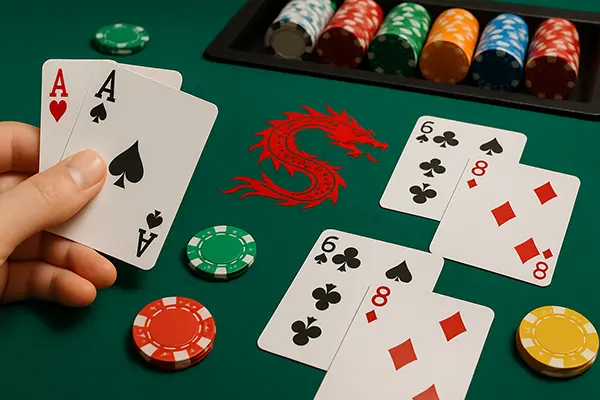
The Dragon Bonus is one of the most complex side bets in modern baccarat variants. It pays based on the margin of victory, with higher payouts assigned to larger point differences. On paper, this structure appears more nuanced than simple binary outcomes.
In practice, the Dragon Bonus concentrates risk into a narrow set of outcomes. Large-margin wins are statistically rare, yet they account for most of the advertised payout potential. Smaller wins offer modest returns that do little to offset long-term losses.
This bet appeals strongly to players who enjoy dramatic swings, but it is fundamentally incompatible with low-volatility play.
When, If Ever, Side Bets Make Sense
From a strictly mathematical perspective, side bets do not improve a player’s expected return. Their value, if any, lies purely in entertainment and short-session volatility rather than sustainable strategy.
There are limited scenarios where a controlled, low-frequency side bet may be used as a variance tool, for example within a fixed entertainment budget where losses are pre-defined and accepted. Even then, expectations should remain realistic.
For players focused on financial discipline, understanding side bets serves a defensive purpose. Knowing why these wagers are structurally unfavourable helps remove emotional decision-making and reinforces long-term bankroll protection.